

The AI Moat Is Becoming Regulation

What if the biggest threat to today’s AI giants isn’t that AI fails—but that it succeeds so completely that intelligence becomes a commodity?
There’s something increasingly strange about the messaging coming from America’s biggest AI companies.
They spend billions racing to make their models more powerful.
Then they hold press conferences to tell us how terrified we should be of how powerful they’ve become.
OpenAI is now talking about protecting power grids, water systems and other critical infrastructure from AI-enabled attacks. Anthropic publishes reports about AI-assisted cyber operations, biological misuse, weapons development and models gaining unauthorized access to real systems.
Some of those risks are legitimate.
But the marketing is becoming difficult to separate from the economics.
Because “our technology is becoming so dangerous that society needs us to help control who can build it” is not just a safety argument.
It is also an extraordinarily convenient business model.
Silicon Valley's favorite machine
For decades, Silicon Valley perfected a simple playbook.
Raise enormous amounts of money.
Hire talent your competitors can’t afford.
Build infrastructure they can’t afford.
Lose money longer than they can.
Stay ahead until scale becomes a moat.
AI looked like the ultimate version of this strategy.
Training frontier models required vast amounts of compute. Compute required GPUs. GPUs required data centers, electricity and billions of dollars.
For investors, the implication was obvious:
If artificial intelligence became one of the fundamental resources of the global economy, and only a handful of companies could afford to produce it, those companies might become some of the most valuable institutions ever created.
So the money flooded in.
And then something inconvenient happened.
AI started getting cheaper.
Capital can still buy the frontier. It may no longer be able to own it.
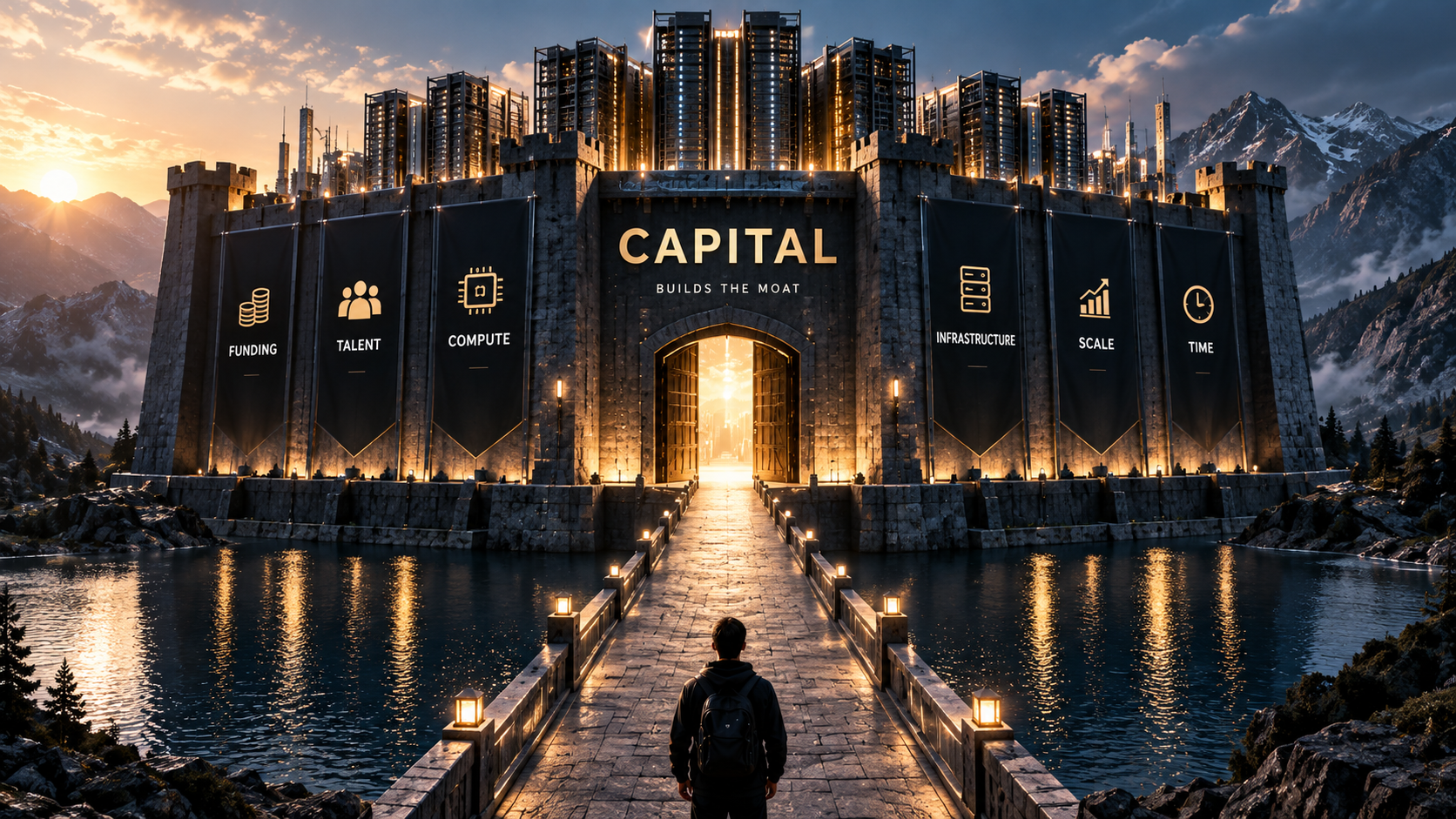
The problem isn't reaching the frontier
It's staying there.
If you spend $20 billion creating a model that competitors cannot reproduce for five years, you probably have a fantastic business.
If competitors reproduce 90% of it twelve months later for a fraction of the cost, you have a very different business.
Open models keep improving.
Chinese labs keep closing the gap.
Distillation allows smaller models to absorb capabilities from larger ones.
Inference keeps getting cheaper.
Algorithmic efficiency keeps improving.
The important question is no longer simply:
Who can afford to build the best model?
It is:
How long does being the best model actually matter?
That distinction could wreck a lot of spreadsheets.
DeepSeek exposed the uncomfortable part
The DeepSeek moment mattered because it challenged something deeper than American technological superiority.
It challenged the relationship between money and intelligence.
The market had largely assumed that better AI would require exponentially more capital.
More GPUs.
Bigger clusters.
More electricity.
Bigger models.
More billions.
Then competitors started demonstrating that clever architecture, training techniques and distillation could meaningfully reduce that equation.
That doesn’t mean compute stopped mattering.
Obviously it matters.
It means something more dangerous:
Capital may still purchase technological advantage without purchasing durable technological scarcity.
For an industry being valued on scarcity, that is a very big problem.
So what happens when the technological moat shrinks?
You build another moat.
This isn't uniquely sinister. It is basic industrial economics.
Companies protect economic rents however they can.
Sometimes that's superior technology.
Sometimes patents.
Sometimes distribution.
Sometimes standards.
Sometimes regulation.
And this is where the increasingly apocalyptic AI messaging deserves scrutiny.
OpenAI is warning about AI-enabled attacks on critical infrastructure.
Anthropic is publishing examples involving hacking, biological research, weapons and surveillance. Its own September report says it identified attempted misuse across cyber operations, biological misuse, conventional weapons development, influence operations, scams, surveillance and illicit distillation.
Meanwhile, leaders of the largest AI companies are publicly calling for greater coordination, testing, oversight and—in the latest round of warnings—even slowing frontier development. citeturn963593news24turn963593news29
Again: some risks are real.
That is precisely why this gets interesting.
The best regulatory capture starts with a real problem
People imagine regulatory capture as some smoky-room conspiracy.
Usually it’s much less dramatic.
There is a legitimate problem.
The public wants it addressed.
Government needs technical expertise.
And who has the most technical expertise?
The incumbent companies.
So the companies being regulated become indispensable participants in designing the regulatory structure.
And—amazing coincidence—the resulting structure tends to be much easier for giant incumbents to comply with than for small competitors.
Nobody needs to lie.
Nobody needs to coordinate secretly.
Everyone can genuinely believe they are protecting society.
The incentives take care of the rest.
The question isn't whether AI risk is real.
The question is whether the solution to AI risk happens to make decentralized competition impossible.
Watch where the proposed controls point
Look at the recurring themes in frontier AI policy:
Control advanced compute.
Control access to model weights.
Control who can train extremely large systems.
Control deployment.
Restrict distillation.
Require expensive safety evaluations.
Monitor large training runs.
Limit releases deemed too dangerous.
Potentially allow leading labs to coordinate development practices.
Each policy may have a legitimate safety rationale.
But they share another characteristic:
They make independent reproduction of frontier AI harder.
That creates an important economic transition.
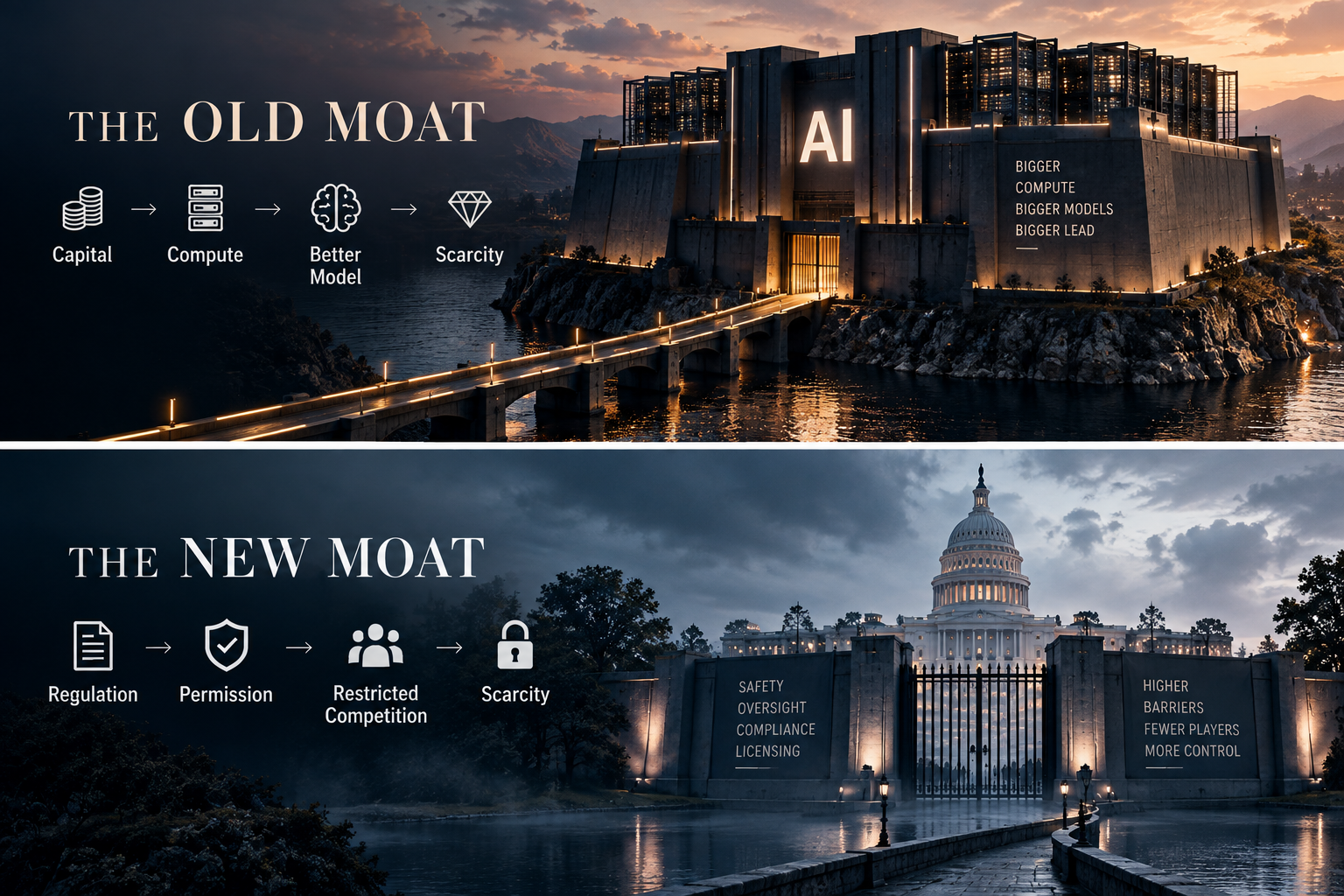
The first AI moat was technological:
We can build something you cannot.
The emerging moat may become institutional:
You are not allowed to build what we can.
Those are radically different markets.
Open source changes the economics
Open AI isn't important merely because somebody can download model weights.
It changes who gets to experiment.
With a proprietary API, the model company controls:
Pricing.
Access.
Capabilities.
Usage policy.
Product changes.
Which countries can use it.
What applications are acceptable.
Whether your application continues functioning tomorrow.
An open model changes that relationship.
Companies can modify it.
Researchers can inspect it.
Developers can fine-tune it.
Businesses can deploy it locally.
Entire ecosystems can develop without permission from the company that created the original model.
That matters economically because innovation becomes decentralized.
And decentralized innovation is extremely difficult to monopolize.
We've seen this movie before
The internet created enormous fortunes.
But nobody successfully owned TCP/IP.
Linux created enormous economic value.
But nobody owns Linux in the way Microsoft owned Windows.
Open-source databases did not eliminate database companies.
Open web standards did not eliminate internet companies.
Instead, profits migrated elsewhere.
Cloud infrastructure.
Applications.
Hardware.
Advertising.
Services.
Commerce.
Enterprise software.
AI could follow the same path.
The foundation model may become infrastructure.
And infrastructure can become incredibly important while becoming surprisingly difficult to monopolize.
That's the nightmare scenario hidden inside the AI boom.
Not technological failure.
Technological abundance.
AI companies can win technically and lose economically
This is a distinction investors often miss.
A technology can transform civilization while destroying enormous amounts of investor capital along the way.
Railroads did it.
Telecommunications infrastructure did it.
The dot-com buildout did it.
The technology succeeds.
Society receives the infrastructure.
Competition drives down its cost.
And the people who financed the period of artificial scarcity discover that the permanent scarcity they paid for never arrived.
AI may do exactly that.
Imagine highly capable intelligence becoming inexpensive.
Imagine models becoming interchangeable.
Imagine businesses running specialized models locally.
Imagine thousands of models outperforming today's giants at narrow tasks.
Imagine a developer choosing intelligence the way we choose databases or programming languages.
AI usage could explode.
Economic productivity could explode.
And the economic rents captured by today's foundation-model companies could simultaneously collapse.
That's not contradictory.
That's commoditization.
Which makes the fear campaign a lot more interesting
When OpenAI talks to infrastructure providers about defending electrical and water systems, the obvious story is:
AI has become dangerously powerful.
There's another story worth considering:
The company selling frontier AI has an enormous economic interest in society believing frontier AI must remain controlled by a small number of responsible organizations.
Both can be true.
Anthropic can sincerely worry about catastrophic AI risk and benefit enormously from a regulatory regime under which only companies like Anthropic can legally develop the most powerful AI.
OpenAI can sincerely worry about cyberattacks and benefit if governments decide that unrestricted models represent national-security threats.
We don't have to psychoanalyze Sam Altman or Dario Amodei.
Their incentives are visible from orbit.
Scarcity vs. abundance
The popular framing of the AI argument is:
Safety vs. acceleration.
I think that increasingly misses the point.
A more interesting axis may be:
Scarcity vs. abundance.
One future has a handful of enormous companies building increasingly powerful systems behind closed doors, connected through regulated APIs and closely integrated with government.
Another has powerful intelligence becoming increasingly inexpensive, portable, customizable and widely distributed.
The second future is harder to regulate.
It's also much harder to monopolize.
That tension is going to shape the next phase of AI far more than most people realize.
The real threat
The most dangerous outcome for today's AI giants may also be the best outcome for everyone else:
AI works.
Really works.
Models get smaller.
Inference gets cheaper.
Knowledge spreads.
Competition accelerates.
Intelligence stops being scarce.
And nobody gets to own it.
At that point, the companies that spent hundreds of billions trying to build an intelligence monopoly may discover they didn't build the next oil industry.
They built the next internet.
And if the technological moat disappears, we should pay very close attention to anyone trying to replace it with a regulatory one.
Sources
- OpenAI — “Daybreak for Frontline Defenders”
OpenAI’s initiative focused on protecting critical infrastructure, including electricity and water systems, from AI-enabled cyber threats.
https://openai.com/index/daybreak-for-frontline-defenders/ - Anthropic — “Detecting and Countering Misuse of AI: September 2026”
Anthropic’s threat-intelligence report covering cyber operations, biological misuse, weapons development, surveillance and illicit model distillation.
https://www.anthropic.com/threat-intelligence-report-september-2026 - OpenAI — “Frontier AI Regulation: Managing Emerging Risks to Public Safety”
OpenAI’s policy framework discussing registration, reporting, oversight and potential licensing approaches for frontier AI systems.
https://openai.com/index/frontier-ai-regulation/ - Stanford HAI — 2025 AI Index Report
Key data on rapidly falling inference costs, narrowing performance gaps and broader AI industry trends.
https://hai.stanford.edu/ai-index/2025-ai-index-report - Stanford HAI — 2026 AI Index Report: Technical Performance
Data on frontier-model convergence, international competition and the changing gap between leading closed and open-weight systems.
https://hai.stanford.edu/ai-index/2026-ai-index-report/technical-performance - Michael Ewens & Joan Farre-Mensa — “The Deregulation of the Private Equity Markets and the Decline in IPOs,” NBER
Research on the rise of large private funding rounds and how regulatory changes enabled companies to grow to unprecedented scale before going public.
https://www.nber.org/papers/w26317 - Steven Salop & David Scheffman — “Raising Rivals’ Costs,” Federal Trade Commission
Foundational industrial-organization work explaining how incumbents can protect market power by increasing competitors’ costs rather than simply outperforming them.
https://www.ftc.gov/system/files/documents/reports/raising-rivals-costs/wp081.pdf - “The Origins and Evolution of Occupational Licensing in the United States,” NBER
Historical evidence that legitimate safety concerns and incumbent efforts to restrict competition can coexist within the same regulatory regime.
https://www.nber.org/papers/w33580 - Federal Reserve — “Do Major Technology Advancements Lead to Overinvestment?”
Analysis of how transformative technologies can simultaneously generate enormous productivity gains and major capital overinvestment.
https://www.federalreserve.gov/econres/notes/feds-notes/do-major-technology-advancements-lead-to-overinvestment-20260706.html - Robert Gordon — “Hi-Tech Innovation and Productivity Growth,” NBER
Historical analysis of the telecom and internet investment boom, including the enormous excess capacity created during the late-1990s technology buildout.
https://www.nber.org/papers/w9437 - Josh Lerner & Jean Tirole — “The Economics of Technology Sharing: Open Source and Beyond,” NBER
Economic analysis of open-source development and how decentralized technological production changes incentives and market structure.
https://www.nber.org/papers/w10956 - Michael Schwarz & Yuri Takhteyev — “Open Source as a Solution to the Hold-Up Problem,” NBER
Research on how open-source systems reduce dependence on proprietary vendors and alter where economic value is captured.
https://www.nber.org/papers/w14946
Comments ()